
What Does AWD Mean on a Car? 26 Easy Facts Explained
What does AWD mean on a car? It’s one of the most common questions car shoppers ask, and the answer matters more than most people realize. AWD stands for all-wheel drive, a drivetrain that sends engine power to all four wheels instead of just two. This setup gives your car extra wheel traction on wet roads, snowy roads, and icy conditions, which makes daily driving safer during rough weather.
This guide breaks down the AWD meaning, how an AWD system actually works, and how it compares to other options like 4WD. You’ll also see real examples of AWD cars, learn about AWD fuel economy, and find out whether an AWD vehicle fits your lifestyle. By the end, you’ll know exactly what to look for the next time you shop for an all-wheel drive system.
What Does AWD Mean on a Car?
AWD on a car means the vehicle’s computer constantly adjusts how much power goes to the front and rear wheels. Instead of relying on one axle to do all the work, the system splits torque distribution based on road conditions in real time.
Read More About: 86 Meaning Slang: Powerful Meaning Explained
This matters most when one wheel loses grip. The car senses the slip instantly and shifts power to the wheels that still have road grip. That’s the core of AWD technology, and it’s why an AWD vehicle feels more planted during sudden weather changes.
AWD Full Form and Meaning
AWD full form stands for all-wheel drive, and the all-wheel drive meaning is straightforward once you break it down. It describes any AWD drivetrain that can power all four wheels rather than just the front or rear pair. Some systems run full-time, while others only activate power to the extra axle when sensors detect a problem. Either way, the goal stays the same: keep the tires gripping the road no matter what’s happening outside.
How AWD Works
How AWD works comes down to sensors, a center differential, and quick decision-making. The differential splits power between axles, and an electronically controlled clutch manages exactly how much torque goes where. If your front tires hit an oily patch on a highway on-ramp, the system reacts in a fraction of a second. It shifts the torque split toward the rear wheels, which still have grip, and keeps the car moving in a straight line instead of sliding.
Types of AWD Systems
Not every AWD system behaves the same way, and the differences affect performance, cost, and fuel use. Manufacturers generally build three main categories, each suited to different driving habits.
Full-time AWD powers all four wheels at all times, which gives the most consistent grip but usually costs more at the pump. Part-time AWD only sends power to the second axle when it’s needed, saving fuel during normal driving. On-demand AWD uses sensors and software to predict slip before it happens, blending performance with efficiency.
| AWD Type | How It Works | Example Vehicles |
| Full-time AWD | Power stays split between axles at all times | Subaru Outback, Audi Quattro |
| Part-time AWD | Engages the rear or front axle only when needed | Honda CR-V, Toyota RAV4 |
| On-demand AWD | Sensors predict slip and adjust power before it happens | Nissan Rogue, Ford Escape |
AWD vs 4WD: What’s the Difference?
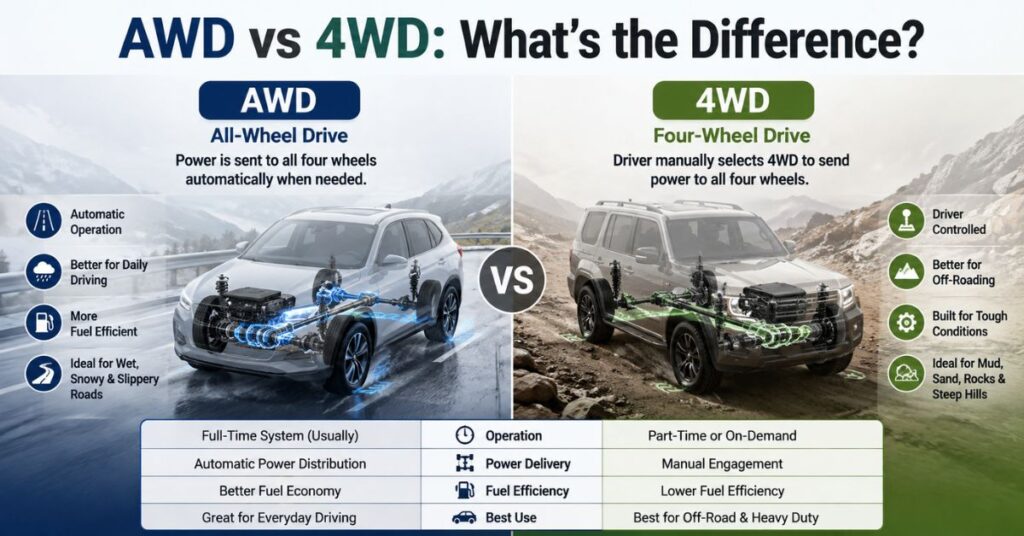
AWD vs 4WD is one of the most confusing topics in car shopping, but the difference between AWD and 4WD is actually simple. AWD works automatically and suits daily commuting, while 4WD gives the driver manual control for serious off-road terrain.
The difference between AWD and 4WD shows up most clearly in how each system handles rough conditions. AWD reacts through electronics and sensors without any driver input. 4WD relies on mechanical locking differentials that a driver selects manually, which makes it tougher for rock crawling or deep mud but less practical for daily highway driving.
Read More About: OTP Meaning Slang: 5 Essential Facts You Should Know
| Feature | AWD | 4WD |
| Engagement | Automatic, full-time or on-demand | Manual, driver-selected |
| Best Use | Daily driving, rain, light snow | Off-road trails, deep mud, rock crawling |
| Fuel Efficiency | Better on average | Lower due to heavier components |
| Common Vehicles | Sedans, crossovers, SUVs | Trucks, rugged off-road SUVs |
When Is AWD Most Useful?
AWD in snow and AWD in rain both show the system at its best. Picture merging onto a highway during a sudden downpour. Standard front-wheel drive cars can struggle with wheel spin, but an AWD vehicle grips the wet pavement and keeps the car stable through the merge.
AWD adds less value on dry, clear roads where traction is already strong. It also isn’t built for AWD for off-road driving in extreme terrain, since ground clearance and tire type matter more than the drivetrain alone. For most drivers in the U.S., though, AWD earns its keep during winter storms, spring rain, and unpredictable mixed-weather commutes.
Benefits of AWD
The benefits of AWD start with AWD traction and stretch into driving stability and cornering control. Cars with AWD often stop shorter on wet pavement and hold their line better through curves compared to two-wheel drive competitors. Resale value also tends to run higher on AWD cars, especially in colder states like Minnesota, Colorado, and New York.
Advantages of all-wheel drive go beyond bad weather too. Many drivers report more confidence during highway merges, sharp turns, and unexpected gravel or debris on the road. That confidence comes from the system’s constant background work, adjusting torque distribution without the driver ever noticing it happen.
Limitations of AWD
Disadvantages of AWD include higher fuel costs and increased AWD maintenance compared to simpler drivetrains. The extra hardware, including a center differential and additional axle components, adds weight and complexity that eventually needs service.
AWD also creates a false sense of security for some drivers. AWD tire requirements still matter a lot, since even the best all-wheel drive system can’t replace proper winter tires on ice. Braking distance depends on tire grip, not drivetrain, so an AWD car with worn tires can still slide on a frozen road.
Read More About: What Does Luster Mean? Definition, Types & Examples
Does AWD Affect Fuel Economy?
Yes, AWD fuel economy typically runs lower than front-wheel drive, though the gap has shrunk with modern engineering. The extra components add weight, and that weight takes more engine power to move.
AWD gas mileage numbers vary by manufacturer, but the table below shows a general pattern drivers can expect across common drivetrain types.
| Drivetrain | Avg Fuel Economy | Notes |
| FWD | 28–35 MPG | Lightest setup, most efficient |
| AWD | 24–32 MPG | Slightly lower due to added components |
| 4WD | 20–28 MPG | Heaviest, built for off-road use |
Which Cars Use AWD?
AWD SUV, AWD sedan, and AWD crossover models all exist across nearly every major brand today. Subaru built its entire lineup around standard AWD, while Audi’s Quattro system remains one of the most recognized names in performance AWD.
Even sports cars use the technology now, with models like the Nissan GT-R relying on AWD for faster acceleration off the line. Interest in AWD electric cars has grown fast too, since electric motors can control torque split between axles with almost instant precision, often outperforming traditional mechanical systems.
Common AWD Misconceptions
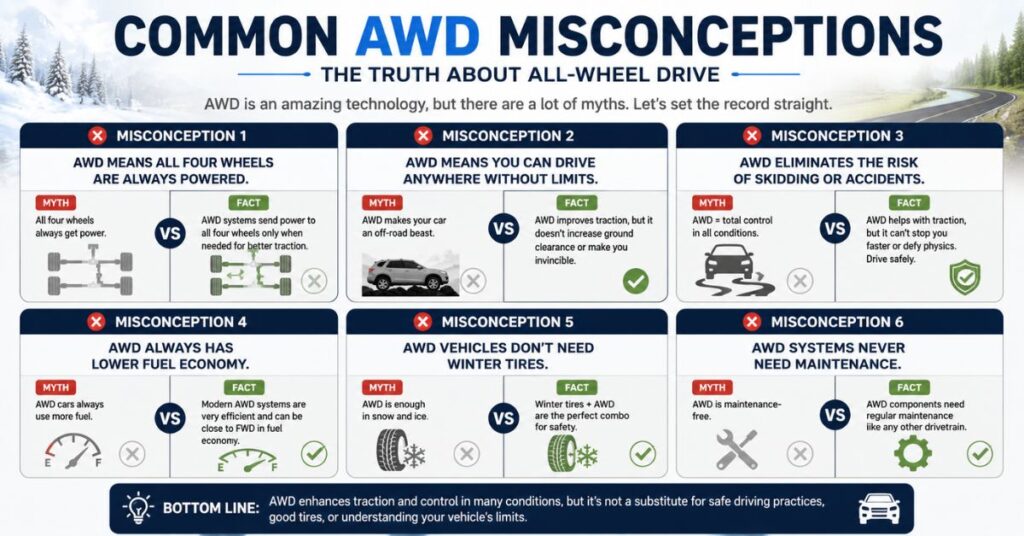
Many drivers assume AWD means all four wheels always receive equal power, but that’s rarely true. Does AWD mean all four wheels are always powered? Not exactly. Most modern systems only shift extra power to a second axle when sensors detect wheel slip, not constantly.
Another common myth claims AWD prevents every accident. In reality, AWD improves AWD safety by boosting traction and handling, but it doesn’t change stopping distance on ice or replace attentive driving. A third myth suggests AWD only belongs on off-road vehicles, when in fact most AWD owners never leave paved roads.
Is AWD Right for You?
Is AWD worth it depends heavily on where you live and how you drive. Drivers in snowy states or areas with frequent rain often see real value from the added AWD capability, especially during winter storms or sudden downpours.
If you live somewhere with mild, dry weather year-round, a standard front-wheel drive car may serve you just as well for less money upfront and lower AWD maintenance costs down the road. Think about your typical commute, your local climate, and how often you drive through rural or unpaved areas before deciding.
Frequently Asked Questions
What does AWD stand for?
AWD stands for all-wheel drive, a system built to send power to all four wheels for better traction and control.
Is AWD the same as 4WD?
No. AWD works automatically through sensors, while 4WD requires the driver to manually engage a separate low-range gear system.
Is AWD better than 4WD?
It depends on the use case. AWD suits daily driving and light weather challenges, while 4WD performs better in extreme off-road terrain.
Do AWD cars have better traction?
Yes, AWD generally improves wheel traction compared to two-wheel drive cars, especially on wet, icy, or loose surfaces.
Does AWD improve handling?
Yes. Because power shifts between axles automatically, AWD often improves cornering grip and overall driving stability at higher speeds.
Can AWD cars go off-road?
Light off-roading is possible, but AWD wasn’t designed for extreme trails the way dedicated 4WD systems are.
Conclusion
So, what does AWD mean on a car? It means a smarter, more capable drivetrain that keeps power flowing to whichever wheels need it most. From AWD in snow to sudden spring downpours, this technology adds real confidence behind the wheel.
It does come with trade-offs, including higher fuel costs and added maintenance, so it’s worth weighing your climate and driving habits before choosing an AWD vehicle. For many U.S. drivers facing unpredictable weather, though, AWD remains one of the smartest upgrades a car can offer.