Meaning in Text Message 77: What Does It Really Mean?
You get a text that says “okay-” and your stomach drops. That tiny dash symbol (-) changes the whole mood of the message. Learning the meaning in text message conversations helps you read hesitation, surprise, or plain typing habits without panic. This guide shows what every dash in a text message really signals.
Most people see a dash as a basic punctuation mark. In text messaging, though, it works like a nonverbal digital cue. It stands in for a pause, a gasp, or a half-finished joke. Below, you’ll find real examples, quick replies, and clear rules for reading texting punctuation meanings with confidence. The meaning in text message threads isn’t random. It follows patterns you can learn.
What Does “-” Mean in a Text Message?
A dash in a text usually marks a pause, an interruption, or an unfinished thought. That’s the core meaning in text message chats, and it leans heavily on context clues. Think of it as a tiny emotional pause that you read instead of hear. Once you spot the pattern, you’ll stop second-guessing every short reply.
Read More About: YH Meaning in Chat: 5 Powerful Things You Should Know!
The Literal Meaning of a Dash
Literally, a dash is a punctuation mark that breaks a sentence or links ideas. A hyphen joins words. An en dash (–) spans ranges like 9–5. An em dash (—) cuts a thought short. Most phones type the short hyphen (-), so that’s the key people actually press. That makes the literal meaning in text message use easy to trace.
What Does a Single Dash Sent Alone Mean?
A single dash sent alone usually means the sender lacks words right now. It can read as awkward silence, a stalled reply, or a nudge for you to keep talking. Say you confess a big secret and get only “-” back. Your friend probably needs a moment. The single dash meaning here is processing time, and the meaning in text message exchanges like this rarely signals anger.
Why People Use Dashes in Texting
People use dashes because text messaging strips out voice and facial expressions. A dash copies how a conversational tone sounds out loud. It’s fast too. One keystroke adds drama that would otherwise need a full sentence. That speed explains why the meaning in text message culture leans on dash punctuation in messages so often.
Different Meanings of a Dash in Text Messages
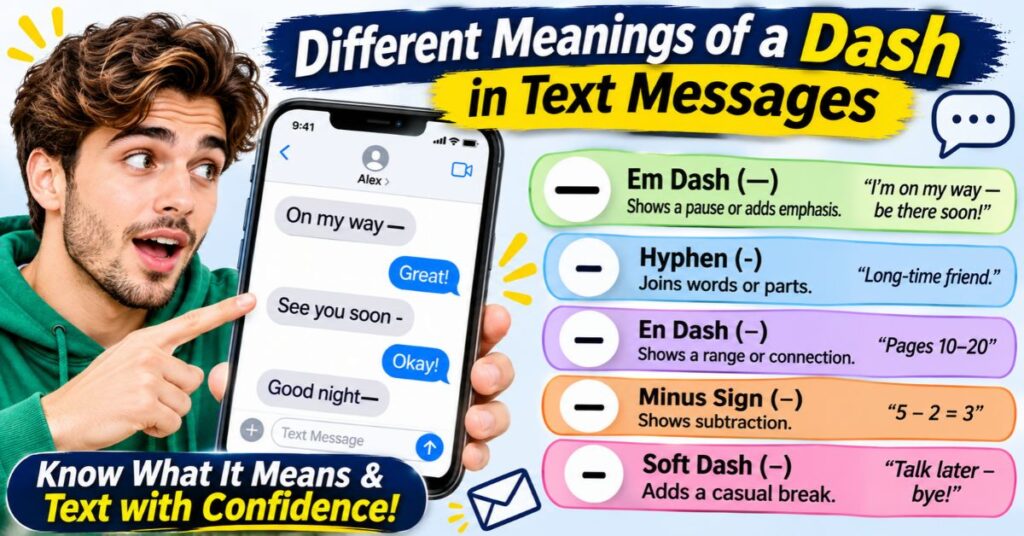
A dash can signal hesitation, surprise, suspense, or an unfinished idea. Each reading shifts with the words around it. These four patterns give you a solid base for message interpretation and for understanding dash meaning in texting. Every pattern adds a piece to the meaning in text message puzzle.
A Dash Can Show Hesitation or Uncertainty
A dash shows hesitation when the sender wants to speak but feels nervous. “I wanted to ask you-” is the classic case. The pause creates uncertainty in communication and makes you wait for the rest. In romantic communication, it often means a confession is brewing. That’s the meaning in text message flirting at its most nervous.
A Dash Can Express Shock or Surprise
A dash expresses shock when it follows a sudden reaction word. “You did WHAT-” is expressing surprise through punctuation at its best. The sender cuts off mid-thought because the news hit hard. Capital letters and a crying emoji usually amplify the unexpected reaction. In these moments the tone is pure surprise rather than anger.
A Dash Can Create Suspense or Awkwardness
A dash creates suspense by hiding the ending. “So I saw who he’s dating-” pulls you in at once. Meanwhile “Oh-” after a joke about someone standing nearby creates an awkward texting moment in two characters. The missing words do all the work. That is suspense in conversation without a single extra letter.
A Dash Can Suggest an Unfinished Thought
A dash suggests an unfinished sentence when the sender stops or switches direction. “I thought you were- never mind” shows an interrupted thought in action. Sometimes the person truly lost their train of thought. Other times they’re being dramatic on purpose. Check the mood before you decide which one you’re seeing.
Read More About: 300+ Clan Names for Clash of Clans (Cool, Funny & Unique)
How Context Changes the Meaning of a Dash
Context decides everything. The same dash can mean teasing from a best friend and tension from a boss. Four social cues matter most: the nearby words, the relationship, the situation, and the sender’s habits. Each one reshapes the meaning in text message exchanges.
The Words Before and After the Dash
The words around a dash give you the strongest clue. “Wait- what?” signals surprise while “Fine-” may signal frustration. Read the full message first. Then check what the other person said right before it. That order delivers reliable message interpretation within seconds, and it rarely fails you.
The Relationship Between the People
The relationship changes how you read the dash. From a best friend of ten years it likely means playful teasing. From a new crush it can mean nerves. From a coworker you barely know it may be a typo. Relationship dynamics shape the emotional context. That in turn shapes the meaning in text message replies.
The Conversation’s Tone and Situation
The conversation’s tone sets the baseline. In a joking group chat a dash adds humor. During an argument that same dash feels cold. Text “Okay-” while planning pizza and nobody blinks. Text it after a fight and it reads as passive-aggressive communication. Situation rewrites the meaning in text message moments every time.
The Sender’s Usual Texting Style
The sender’s usual style matters most of all. Some people drop dashes into every message as part of their personal communication style. If your friend does it daily, one more dash means nothing new. A sudden shift away from their normal communication style deserves more attention than the dash itself.
Common Dash Expressions and Their Meanings
Certain words pair with dashes again and again. Each combination belongs to a family of online texting expressions. The table gives you the quick version before the closer look. Knowing these shortcuts speeds up your read of the meaning in text message slang.
| Expression | Usual Meaning | Typical Tone |
| Wait- | Sudden realization | Surprised |
| Oh- | Awkward discovery | Uneasy |
| Okay- | Doubt or confusion | Hesitant |
| But- | Stopped objection | Reluctant |
| I mean- | Searching for words | Nervous |
| Bro- | Disbelief | Humorous |
| You actually- | Dramatic shock | Teasing |
| -_- | Annoyance | Unimpressed |
What Does “Wait-” Mean in Texting?
“Wait-” means the sender just noticed or realized something. It’s a dramatic pause squeezed into one word. Text “I’m engaged” and expect “Wait-” followed by a flood of questions. The dash shows their brain outrunning their thumbs. That’s typical meaning in text message behavior when big news lands.
What Does “Oh-” Mean in a Text?
“Oh-” signals awkward realization or mild surprise. It often appears when someone learns something they’d rather not know. Mention your date’s name and your friend answers “Oh-” because they know that person. The dash carries the awkward silence so nobody has to say it out loud.
What Does “Okay-” Mean in Texting?
“Okay-” means the sender feels unsure or interrupted. It sounds less final than “Okay.” with a period (.). Suppose you propose dinner at 9 p.m. and get “Okay-” back. They may doubt the time. Ask a quick follow-up before you book the table.
What Does “But-” Mean in a Message?
“But-” means the person wants to object and stops. They might fear a fight. Alternatively, you may have cut them off. A friend who answers “But-” after you announce a big road trip likely has a scheduling problem. Ask what’s up before you assume anything.
What Does “I Mean-” Mean in Texting?
“I mean-” shows someone hunting for the right words. It often comes before a difficult or embarrassing explanation. Picture a friend who forgot your birthday typing “I mean-” ahead of an apology. That hesitation in texting buys them time to think. It also warns you that an explanation is coming.
What Does “Bro-” Mean in a Text?
“Bro-” expresses disbelief or amused frustration. It’s pure informal texting language. A guy sends it after a ridiculous video and the other guy knows the feeling instantly. The dash replaces a long rant about how absurd the moment was. Close friends use it constantly.
What Does “You Actually-” Mean?
“You actually-” signals dramatic disbelief. The sender can’t believe what you did. Admit you ate cereal for dinner three nights running and “You actually-” says it all. They leave the rest unsaid because the shock speaks loudly enough. The meaning in text message teasing needs no more words.
What Does “-_-” Mean in Texting?
“-_-” isn’t a plain dash. It’s an old-school texting emoticon showing annoyance or an unimpressed face. The underscore (_) forms a flat mouth between two dash eyes. Friends often send it after a bad pun. Unlike a lone dash, this combination states the mood outright.
How Dashes Change the Tone of a Text Message
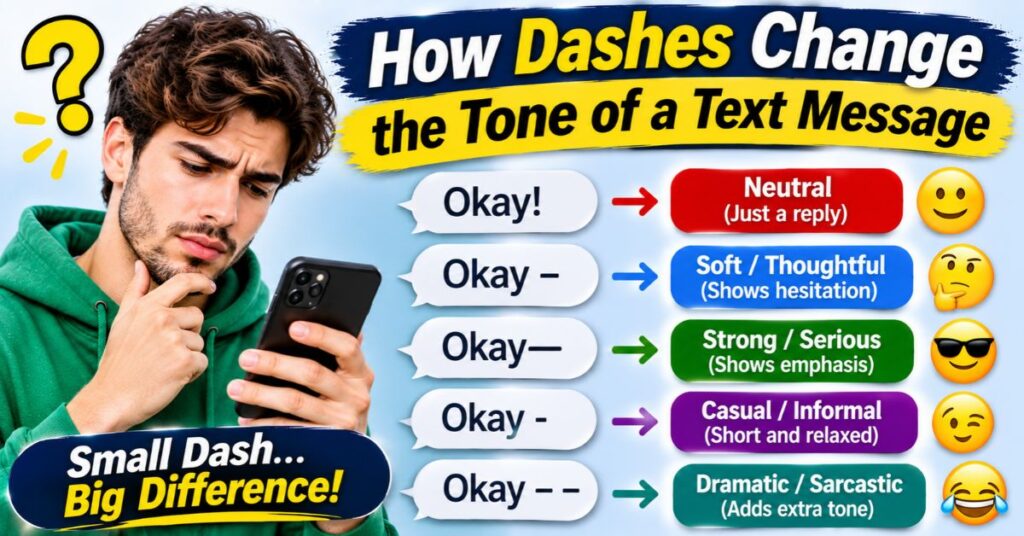
A dash makes a message sound interrupted while other marks sound final, excited, or lingering. Tone shifts with every punctuation combination. The table shows the main contrasts at a glance and clarifies the meaning in text message tone.
| Mark | Example | Typical Tone |
| Dash | “Okay-” | Interrupted and unsure |
| Period (.) | “Okay.” | Final and serious |
| Ellipsis (…) | “Okay…” | Trailing and doubtful |
| Exclamation mark (!) | “Okay!” | Excited |
| Question mark (?) | “Okay?” | Curious |
| No punctuation | “okay” | Casual |
Dash vs. Period: What’s the Difference?
A period (.) sounds final and sometimes cold while a dash sounds open and unsure. “Okay.” can end a conversation. “Okay-” invites more. Want warmth? Skip the period after short replies. It matters because texting tone drives the meaning in text message reactions more than the words alone.
Dash vs. Ellipsis: What Changes?
A dash cuts a thought off sharply. An ellipsis (…) fades it out slowly. “Okay…” sounds trailing and doubtful. “Okay-” sounds interrupted mid-breath. The ellipsis feels moodier and the dash feels punchier. Both shape the meaning in text message pauses.
Dash vs. Exclamation Mark
An exclamation mark (!) adds energy while a dash adds a stumble. “Okay!” feels cheerful. “Okay-” feels unsure. Pair a dash with capital letters as in “WAIT-” and you get drama instead of joy. The contrast is easy to feel once you see both versions side by side.
Dash vs. No Punctuation
No punctuation sounds relaxed and neutral. A dash adds a beat of emotion. A lowercase “okay” reads as casual agreement. Add a dash and it reads as a pause. That single character is often the only nonverbal digital cue available. It guides the meaning in text message tone more than most people notice.
Examples of Dash Meaning in Real Conversations
Real chats show the dash at work better than theory. Each app has its own rhythm. These examples show how dash meaning in text shifts across platforms and relationships. Every one adds to the meaning in text message picture you’re building.
Dash Meaning in WhatsApp Conversations
On WhatsApp messaging, a dash often shows hesitation during personal talk. Mia asks, “Did you tell Sarah everything?” Jake replies, “I mean-” and Mia answers, “You did.” Jake’s dash confesses without a word. This dash in WhatsApp messages pattern shows the meaning in text message guilt clearly.
Dash Meaning in Instagram DMs
In Instagram direct messages, the dash adds playful flair. Someone writes, “Your new profile picture is actually cute.” The reply is “Actually-?” with a laughing emoji. This dash in Instagram DMs fakes outrage and keeps things light. It’s the friendliest side of Instagram DMs humor.
Dash Meaning in TikTok Comments
In TikTok comments, the dash turns a thought into a joke. A viewer writes, “Why did he look straight at the camera-” and thousands agree. Nobody needs the ending. The cut-off line works as shared humor in social media communication. That’s the meaning in text message comedy, public edition.
Dash Meaning Between Friends and Couples
Between friends and couples, the dash carries more emotional weight. A friend may tease with “Girl-”. A partner may text “I just-” before sharing a worry. For the meaning of a dash from a girl or the meaning of a dash from a guy, the answer matches: read the tone and not the gender. The meaning in text message romance depends on relationship dynamics.
Dash Meaning in Professional Messages
In professional messages a dash looks unfinished. “I reviewed the document-” leaves your manager waiting for the rest. Use full sentences at work. Save the playful dash for friends. Good texting etiquette protects your credibility and keeps the message clear for everyone who reads it.
How to Respond When Someone Sends a Dash
Reply to the mood and not the symbol. A short warm response works in nearly every case. Pick the style that fits your bond. Smart replies protect the meaning in text message exchange from drifting into misunderstanding.
Casual Responses to a Dash
Casual replies keep things easy. Try “What happened?” or “Go on.” or “You were saying?” Each one invites the person to finish the thought. These suit friendly conversation because they feel light. You sound curious instead of pushy, and the sender relaxes.
Funny Responses to Keep the Conversation Going
Funny replies keep the mood high. Try “Bro stopped mid-sentence” or “Don’t leave me hanging.” Humor relaxes the sender and pulls out the full story faster. Match the joke to the sender’s texting tone first. A joke at the wrong moment can backfire.
Respectful Responses When the Meaning Is Unclear
Respectful replies fit moments when the tone feels heavy. Try “Take your time” or “I’m here if you want to talk.” These give space without pressure. They also show care when the emotional context isn’t obvious. Gentle words protect the meaning in text message sincerity.
When to Ask for Clarification
Ask for clarification when two readings feel equally likely. A simple “What did you mean?” solves most confusion. Do it early. Waiting lets misunderstood messages grow into real arguments. A ten-second question costs far less than a ruined evening. Clear answers also settle the meaning in text message puzzles for good.
Common Misunderstandings About Dashes in Texting
Most dash myths start with assuming the worst. Dashes carry many moods and anger is only one of them. These four corrections will save you stress and sharpen how you read the meaning in text message threads.
Does a Dash Mean Someone Is Angry?
No, a dash doesn’t automatically mean anger. It can signal confusion, nerves, or humor. A friend who texts “Wait-” after a party invite probably feels thrilled. Look for harsher words or a sudden cold tone before you conclude frustration. Evidence beats instinct every time.
Is a Dash Always a Sign of Annoyance?
No, a dash isn’t always a sign of annoyance. Plenty of people type one out of habit. Others use it for playful sarcasm. A true annoyance reading needs more evidence such as clipped replies or long delays. Without that proof the meaning in text message annoyance stays unproven.
Is a Dash Considered Texting Slang?
Technically, no. A dash is a punctuation mark rather than a word. Online culture has still given it slang-like jobs. That makes it feel like internet slang in practice. The dash symbol meaning therefore lives somewhere between grammar and informal language.
Why You Shouldn’t Interpret One Punctuation Mark Alone
One mark never tells the full story. Timing, wording, and history add the rest. Treat the dash as one of several context clues. Over-reading a single character creates misunderstood messages and needless worry. A calm look at the whole thread gives you the real meaning in text message conversations.
Why People Use Dashes Differently in Digital Communication
People use dashes differently because age, culture, platform, and personality all shape habits. No single rulebook governs digital communication. Each factor below explains one slice of the picture.
Generational Differences in Texting Habits
Younger users, especially Gen Z, use dashes to mimic speech and add humor. Millennials use expressive punctuation too but often favor the ellipsis. Older users may treat a dash as plain grammar. So the same message can land three different ways. Each group reads the meaning in text message style differently.
Cultural and Regional Differences
Cultural background shapes how you read dashes. Bilingual users often mix English, local languages, and emojis in a single thread. A dash that sounds dramatic to one reader may look purely grammatical to another. Don’t assume emotion without checking first.
Social Media and Internet Culture
Internet culture spreads punctuation habits quickly. A trend on TikTok soon reaches Snapchat conversations and Discord servers. Messenger chats pick up the same style. Memes teach users to type like they talk. Over time digital messaging habits converge around expressive marks like the dash.
Personal Texting Style and Preferences
Personal style explains the rest. Some people type in all lowercase with dashes everywhere. Others never touch them. Learn each person’s baseline first. A change from it signals something and a repeat of it signals nothing. That’s the meaning in text message personality in practice.
When Should You Avoid Using a Dash in Text Messages?
Avoid dashes when clarity matters more than style. They suit playful chats but not every setting. Three situations call for extra care.
Sensitive or Serious Conversations
Skip the dash during serious or emotional talks. “Fine-” mid-argument can sound like passive-aggressive communication even when you mean nothing by it. Write a full sentence instead. “I’m upset and I need a minute” leaves no room for guessing. Clear words keep everyone calm.
Professional and Formal Communication
Skip it in formal messages too. Emails to recruiters, teachers, and clients need full sentence structure. A stray dash makes you look rushed. Reserve informal language for people who know you well. Formal settings follow stricter rules than the casual habits you share with friends.
Situations Where Clarity Matters Most
Choose clarity when a decision, date, or deadline sits in the message. “Meet at 5-” could mean 5:00 or 5:30 or a plan change. Finish the thought. Your reader shouldn’t need context clues to learn where to stand. Precise writing removes doubt about the meaning in text message instructions.
Frequently Asked Questions
What Does a Dash Mean When Someone Texts It Alone?
It usually signals a pause, a stunned moment, or speechlessness. The sender may be waiting for you to continue. Check what you said right before it arrived. A single dash message after big news often means “I’m processing.” After a joke it may mean “I can’t even.” Timing tells you most.
Does a Dash Mean Someone Is Mad at You?
Not usually. Anger needs more evidence than one symbol. Short replies, long silences, and sharp words together point to frustration. A dash by itself points to very little. If you’re worried, ask directly and keep your question friendly. Most people answer honestly when you ask kindly.
What does 🙂 in texting mean?
🙂 usually represents a smile, showing happiness, friendliness, or a positive tone in a text conversation.
What does “you” mean in a text message?
“You” refers to the person receiving the message. Its exact meaning depends on the conversation and context.
What does the 3 symbol mean in text?
The symbol “
Conclusion
The meaning in text message dashes comes down to tone. A dash can show hesitation, surprise, humor, or an unfinished sentence. It rarely means one fixed thing. Instead it borrows meaning from the nearby words, the relationship, and the sender’s habits. That flexibility keeps the meaning in text message culture evolving.
So next time you see “Wait-”, “Oh-”, or a lone “-”, stay calm. Read the context clues. Check the sender’s usual communication style. Then reply with curiosity instead of worry. When doubt lingers, ask. One short question beats ten minutes of guessing. It also gives you the true meaning in text message conversations straight from the source.