What Does I Plead the 5th Mean? Easy Explanation
Picture a courtroom scene. A witness sits in the chair, lawyers circle with questions, and then it happens: “I plead the Fifth.” Everyone in the room knows exactly what that means, but do you? If you’ve ever wondered what does i plead the 5th mean, you’re not alone. Millions of Americans hear this phrase on the news, in TV dramas, and even in casual conversation without fully grasping the legal weight behind it.
This phrase traces back to one of the most important protections in the U.S. Constitution. It gives people a way to avoid self-incrimination during police questioning, court testimony, or even a congressional hearing. Understanding what does i plead the 5th mean isn’t just trivia. What Does I Plead the 5th Mean It’s practical knowledge that could matter if you ever find yourself facing a criminal investigation or sitting for a deposition.
What Does I Plead the 5th Mean?
Saying “I plead the Fifth” means you’re refusing to answer a question because your answer might incriminate yourself. It’s a direct invocation of your Fifth Amendment rights, and it works as a legal shield during questioning by law enforcement or formal court proceedings.
Read More About: Sherm Meaning Slang: 7 Powerful Facts & Uses
The phrase comes from the Fifth Amendment to the U.S. Constitution, which protects you from being forced to give compelled testimony against yourself. When someone asks what does plead the Fifth mean, the short answer is this: it’s your constitutional right to stay quiet rather than hand over incriminating evidence. You don’t need to explain why. You just invoke it, and the conversation stops there.
What Is the Fifth Amendment?
The Fifth Amendment is part of the Bill of Rights, ratified in 1791 as one of the first ten amendments to the U.S. Constitution. What Does I Plead the 5th Mean It guarantees several individual rights, including protection from self-incrimination and the right to due process under federal law.
Beyond the right to remain silent, the Fifth Amendment also protects you from double jeopardy and guarantees a grand jury indictment for serious crimes. However, most people know it best for one specific line:
no person “shall be compelled in any criminal case to be a witness against himself.” That single clause is the backbone behind every answer to what does I plead the Fifth mean, and it’s why the phrase carries so much legal power even outside a courtroom.
When Can You Plead the Fifth?
Can you plead the Fifth any time you want? Not exactly. What Does I Plead the 5th Mean The protection applies specifically when your answer could create criminal liability, and it shows up in several distinct legal situations.
| Situation | Who Can Use It | Common Setting |
| Criminal case | Defendant or witness | Trial, grand jury |
| Police interrogation | Suspect | Arrest, criminal investigation |
| Civil case | Witness, party to lawsuit | Deposition, subpoena |
In a Criminal Case
In a criminal case, both the defendant and any witness can refuse to answer questions that might expose them to prosecution. A defendant’s rights include never having to take the stand at all, and prosecutors can’t comment on that silence to the jury.
During Police Questioning
During police interrogation, you can invoke your rights the moment officers start asking questions that could lead to criminal liability. This is closely tied to Miranda warnings, which remind you of your Fifth Amendment right to silence before any custodial questioning begins.
Read More About: What Does a Yellow Rose Mean? 7 Amazing Meanings
In a Civil Case
Yes, can you plead the Fifth in a civil case? You can, but the outcome differs sharply from a criminal trial. In a civil case, a judge or jury can draw a negative inference from your silence, so refusing to answer might hurt your position even though it’s still legally allowed.
What Happens When You Plead the Fifth?
What happens when you plead the Fifth depends heavily on the type of proceeding you’re in. In a criminal case, the judge simply moves on. The jury cannot treat your silence as proof of guilt, and your attorney doesn’t need to explain the refusal further.
In a civil case or a congressional hearing, things play out differently. Attorneys can keep asking the same question repeatedly to make the refusal look suspicious in front of a jury, and in civil court, an adverse inference rule (a rule letting jurors assume the answer would’ve been unfavorable) may apply against you. This is one reason people sometimes hesitate to invoke your rights, even when the law fully supports doing so.
Examples of “I Plead the Fifth” in Real Life
Examples make the concept much easier to understand than abstract legal language. A corporate executive facing a shareholder lawsuit might sit for a deposition and refuse to answer questions about internal emails. A witness called before a congressional hearing investigating financial fraud might repeat “I plead the Fifth” dozens of times to avoid handing prosecutors a roadmap for future charges.
| Scenario | Setting | Reason for Refusal |
| Executive in fraud lawsuit | Deposition | Avoid incriminating evidence |
| Witness in criminal trial | Court testimony | Protect against self-incrimination |
| Public figure in hearing | Congressional hearing | Prevent criminal prosecution |
These situations show that pleading the Fifth isn’t reserved for hardened criminals. Business owners, public officials, and everyday citizens use this protection whenever a truthful answer could expose them to legal risk.
Can Pleading the Fifth Make You Look Guilty?
Does pleading the Fifth mean you are guilty? Legally, no. The Fifth Amendment exists precisely so innocent people aren’t pressured into making a potentially harmful statement out of fear or confusion during high-pressure questioning.
That said, public perception often works differently than the law. Juries are instructed to ignore silence in a criminal case, but reporters, social media users, and casual observers rarely follow that same rule. Someone like a business executive who refuses to answer questions in a widely covered congressional hearing might face reputational damage even if no charges ever get filed. The legal protection stays intact; the public relations fallout does not.
What Is the Difference Between “Plead the Fifth” and “Take the Fifth”?
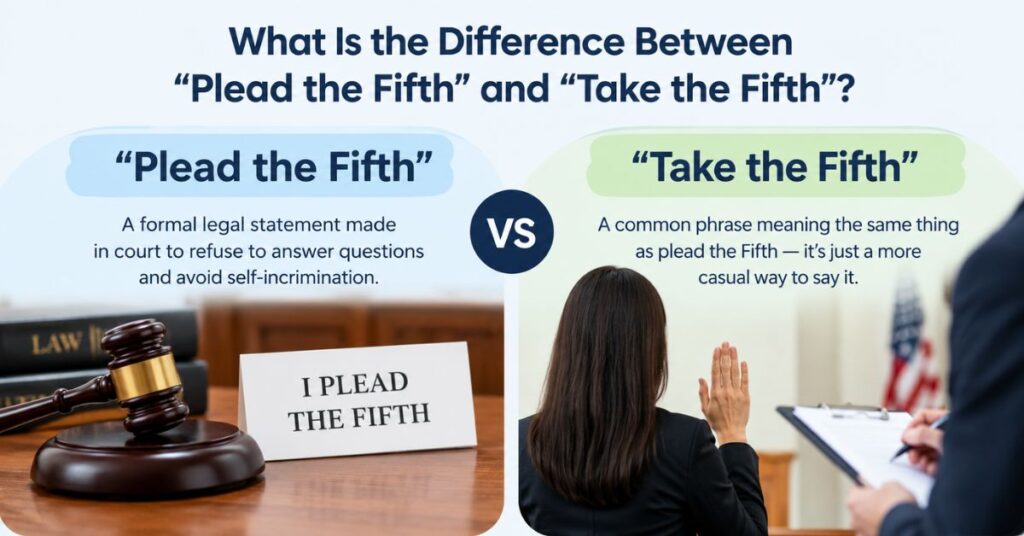
What does take the Fifth mean compared to pleading it? Functionally, nothing. These two phrases are interchangeable in everyday speech, and both refer to the same constitutional protection against self-incrimination.
| Phrase | Formality | Common Usage |
| Plead the Fifth | Slightly more formal | Legal writing, courtroom dialogue |
| Take the Fifth | More casual | Everyday conversation, news headlines |
The distinction comes down to tone rather than legal meaning. “Take the Fifth” feels more conversational, while “plead the Fifth” sounds a bit more official. Either way, both phrases point back to the same legal protection rooted in the Fifth Amendment.
Conclusion
Understanding what does i plead the 5th mean comes down to one core idea: it’s your constitutional right to remain silent rather than provide testimonial evidence that could hurt you legally. Whether you’re facing police questioning, sitting through a deposition, or testifying at a criminal case, this protection exists to keep the government from forcing you to testify against yourself.
The phrase might sound dramatic on television, but its real purpose is practical and deeply rooted in fairness. Knowing your legal rights, including when and how to invoke your rights, puts you in a stronger position no matter what kind of legal situation you encounter. That knowledge alone is worth far more than the courtroom drama that usually surrounds it.