What Does Hydrophilic Mean? 10 Clear Facts Explained
If you’ve ever asked what hydrophilic means, the short answer is simple: it describes anything that loves water. Scientists use this term to describe substances, molecules, or surfaces that attract, absorb, or dissolve in water instead of pushing it away. What Does Hydrophilic Mean You’ll find this concept everywhere, from the soap in your shower to the cells inside your body.
Understanding hydrophilic meaning helps you make sense of chemistry, biology, and even the products you use every day. This guide breaks down the hydrophilic definition, explains the science behind it, and shows you real examples you can actually picture. No jargon overload here, just clear, practical explanations.
The Origin and Core Definition of Hydrophilic
The word comes from two Greek roots: “hydro” for water and “philic” for loving. Put them together and you get a term that literally means water-loving.
Read More: 7 Powerful SMH Meaning Slang Examples You’ll Love
In practical terms, hydrophilic substances interact easily with water molecules because of their chemical structure. Most contain polar groups like hydroxyl groups or amino groups, which create an affinity for water at the molecular level. Sugar dissolving in your coffee is a perfect everyday example of this attraction to water in action.
Hydrophilic vs Hydrophobic: Understanding the Difference
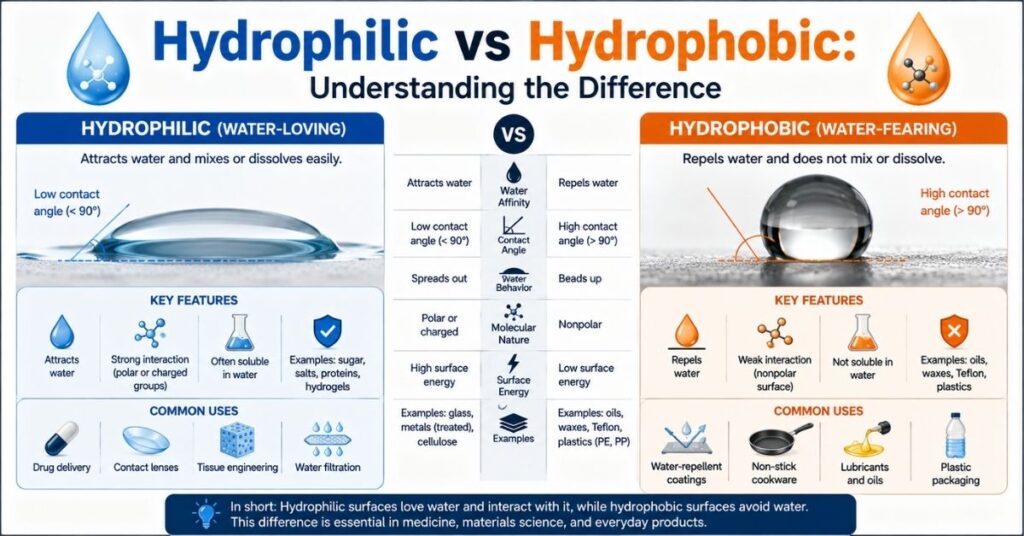
Every water-related property has an opposite, and that opposite is hydrophobic. While hydrophilic molecules attract water, hydrophobic ones repel it entirely, which explains why oil and water never mix.
This contrast between polar and nonpolar substances shapes how materials behave in nature and industry. The table below breaks down the core differences so you can compare them side by side.
| Property | Hydrophilic | Hydrophobic |
| Water behavior | Attracts and absorbs water | Repels water completely |
| Molecular type | Polar or charged | Nonpolar |
| Common examples | Salt, sugar, cellulose | Oil, wax, silicone |
| Solubility | Dissolves in water | Insoluble in water |
| Surface behavior | Low contact angle | High contact angle |
The Science Behind Hydrophilic Properties
Hydrophilic properties come down to one thing: how a molecule’s electrons are distributed. Molecules with uneven charge distribution, known as polar molecules, create partial charges that pull toward the partial charges in water.
This molecular polarity allows hydrogen bonding to form between the substance and surrounding water molecules. What Does Hydrophilic Mean Ions and charged molecules work the same way, using electrostatic interactions to stay dissolved in an aqueous environment. Without this bonding, solubility simply wouldn’t happen.
Common Hydrophilic Molecules and Compounds
Some hydrophilic compounds show up constantly in chemistry class and daily life. Glucose, table salt, and ethanol all dissolve readily in water because their structure supports strong molecular interactions with it.
Amino acids offer another clear case. What Does Hydrophilic Mean Certain ones, like serine and lysine, contain hydroxyl groups or amino groups that face outward toward water in proteins. This behavior directly affects how proteins fold and function inside living cells.
Hydrophilic Surfaces and Materials in Real Life
A hydrophilic surface doesn’t just interact with water chemically. It also changes how water physically behaves when it touches that surface, spreading out instead of forming droplets.
Cotton fabric, paper towels, and certain glass coatings all count as hydrophilic materials because of this water absorption ability. What Does Hydrophilic Mean Engineers rely on hydrophilic coating technology for eyeglasses, medical tools, and anti-fog surfaces, since these coatings improve water compatibility on otherwise slick materials.
Read More: What Does Prospect Mean? 8 Easy Examples & Uses
Biological Importance of Hydrophilic Molecules
Life itself depends on hydrophilic molecules working correctly. Cell membranes contain phospholipids with hydrophilic heads facing outward and hydrophobic tails tucked inside, creating a barrier that still allows communication with the watery environment around it.
DNA relies on this same principle. What Does Hydrophilic Mean Its phosphate backbone stays soluble in water thanks to strong water affinity, which keeps the genetic code stable inside cells. Carbohydrates and biological molecules throughout the body use similar strategies to stay dissolved in blood and cytoplasm.
Hydrophilic Interactions and Hydrogen Bonding Explained
Hydrophilic interactions rely heavily on hydrogen bonds forming between molecules and water. These bonds happen when oxygen atoms or nitrogen atoms carry a slight negative charge that attracts the slightly positive hydrogen in water.
This type of surface chemistry explains why some materials feel “wet-friendly” while others don’t. Stronger intermolecular forces mean better solubility and more stable molecular interactions over time, which matters a lot in pharmaceutical formulation.
Hydrophilic Polymers, Hydrogels, and Modern Applications
A hydrophilic polymer can absorb enormous amounts of water without dissolving completely, and that’s exactly what makes a hydrogel so useful. Some hydrogels hold up to 90% water by weight, mimicking the softness of real body tissue.
This property makes them essential for contact lens materials, wound dressings, and drug delivery systems. In tissue engineering, hydrogels support cell growth while maintaining the moisture that living tissue needs to survive.
Everyday Examples of Hydrophilic Substances
You interact with hydrophilic examples more often than you think. Soap works because one end of the molecule shows strong water affinity while the other end grabs onto grease and oil.
Skincare products use the same logic. Moisturizers often include ingredients built for water absorption, helping skin retain hydration throughout the day. Even cooking depends on this concept, since salt and sugar dissolve into sauces and dough because of their natural attraction to water.
Factors That Affect Hydrophilicity
Hydrophilicity isn’t a fixed trait. It changes depending on temperature, pH, and the specific chemical properties of a given molecule.
Molecular size plays a role too. Larger molecules sometimes struggle to fully engage in hydrogen bonding, even when they contain polar groups, because their structure limits how much surface area actually touches water molecules. Ionic strength in a solution can also boost or weaken electrostatic interactions, shifting how well something dissolves.
Read More: Salty Slang Meaning: 15 Surprising Things It Really Means
How Scientists Test Hydrophilic Properties
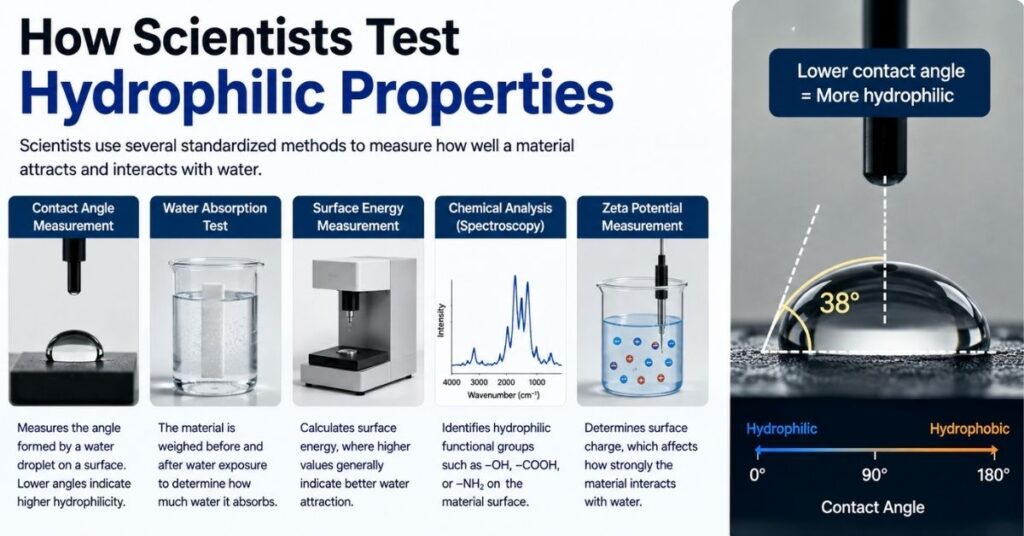
Researchers rely on a few reliable methods to measure hydrophilic properties in a lab setting. The most common one measures contact angle, which tells you how a water droplet behaves on a given surface.
| Test Method | What It Measures | Hydrophilic Result |
| Contact angle test | Droplet shape on surface | Angle below 90 degrees |
| Solubility test | Dissolving rate in water | Dissolves quickly |
| Surface energy test | Molecular attraction strength | High surface energy |
Lower contact angle readings indicate stronger wettability, meaning water spreads out instead of beading up. This kind of surface chemistry testing helps manufacturers design better medical devices, filtration membranes, and industrial coatings.
Frequently Asked Questions
What Does Hydrophilic Mean in Medical Terms?
In medical terms, hydrophilic means a substance or material that attracts and interacts easily with water. It is commonly used for water-compatible drugs, coatings, polymers, and medical devices.
What Is the Difference Between Hydrophobic and Hydrophilic?
Hydrophilic substances attract water and tend to interact with or dissolve in it, while hydrophobic substances repel water and generally do not mix well with it.
Is H₂O Hydrophilic?
Yes, H₂O (water) is hydrophilic because water molecules readily interact with other polar or charged substances through hydrogen bonding.
How to Tell Hydrophilic vs Hydrophobic?
A hydrophilic surface usually allows water to spread or form a low-angle droplet, while a hydrophobic surface makes water bead up into a high-angle droplet.
Conclusion
So, what does hydrophilic mean in the bigger picture? It describes one of the most important relationships in science: the bond between certain molecules and water itself. From cell membranes to skincare products, this water-loving behavior shapes biology, chemistry, and everyday materials in ways you interact with constantly.
Once you understand hydrophilic substances and their opposite, hydrophobic ones, you start noticing this pattern everywhere, from your morning coffee to the biomedical applications shaping modern medicine.